
Age of Personal Software
I’ve stopped looking for software, and that might mean bad things for open source and SaaS.
For years, when I needed a tool, I’d go hunting. Freeware, shareware, some open source project on GitHub, a SaaS with a free tier. I still have the reflex. But more and more I catch myself skipping the search and building the thing myself. It’s usually faster, and it actually fits.
I’m not alone in this. Back in 2020, Robin Sloan wrote An App Can Be a Home-Cooked Meal. His point: when you drop the requirement for software to be professional and scalable, programming becomes a different activity, closer to cooking dinner for people you love than running a restaurant. He built a tiny app with almost no interface for his own family and left it there. Maggie Appleton picked up the thread in 2024 and named the people who do this barefoot developers, predicting a “golden age of local, home-cooked software” as language models lower the bar. That’s the age I think we’ve walked into.
People used to organize their lives in spreadsheets. Then came low-code, Airtable and its cousins, a friendlier layer over a database. Now people reach for an agent. My brain is still stuck one step back, in the world of apps built to do one job that I can drop into a bookmark. So that’s what I make, and when I want one to change, I ask Claude Code to change it. It’s low code, except the code is real and it’s mine. Simon Willison draws the line this way: if you never read the code, that’s vibe coding; if you review it, it’s just software development. I read mine, which is probably why the apps stick around.
Enshittification
I’ve been burned too many times. The good ones keep dying or curdling.
Cory Doctorow has a word for the curdling: enshittification. A three stage process: first the platform is good to its users, then it abuses its users to please its business customers, then it abuses the business customers to claw back all the value for itself. “Then, they die.” The American Dialect Society made it word of the year for 2023, which tells you how widely people recognized it.
The death that still stings is Google Reader. From 2005 to 2013 it was the best news experience on the internet, and I mean that literally: personalized without being a slot machine, showing me exactly what I subscribed to, in order. Google killed it in 2013. Dave Winer put it plainly: the founders felt the company had too many products. Reader wasn’t broken, it just wasn’t the business they wanted. They went all in on YouTube instead, and the rest of us got doom scrolling.
Google Reader is the clean version of the story, a beloved thing switched off in one move. The slower death is acquisition. TripIt used to be the best trip organizer going, an independent app that just worked. Concur bought it in 2011, SAP swallowed Concur in 2014, and somewhere in there it quietly stopped getting better. It’s now a consumer app buried two acquisitions deep in enterprise expense software, which is about the least likely place for anyone to lovingly maintain it.
So I rebuilt it
AITube folds YouTube, RSS, and podcasts into one timeline. I’ve mentioned it here before, since Rex, my Hermes agent, keeps its playlists curated, but I’ve never explained what it is.
It shows everything I subscribe to in order. It scores new videos against a model of what I actually find interesting, so the top of the feed is what I want, not what’s engineered to keep me watching. It clusters what I’ve watched into topics so I can see the shape of my own attention. And it has the controls I always wished YouTube had: I’ve put a blocker on real YouTube in my phone browser and uninstalled the app.
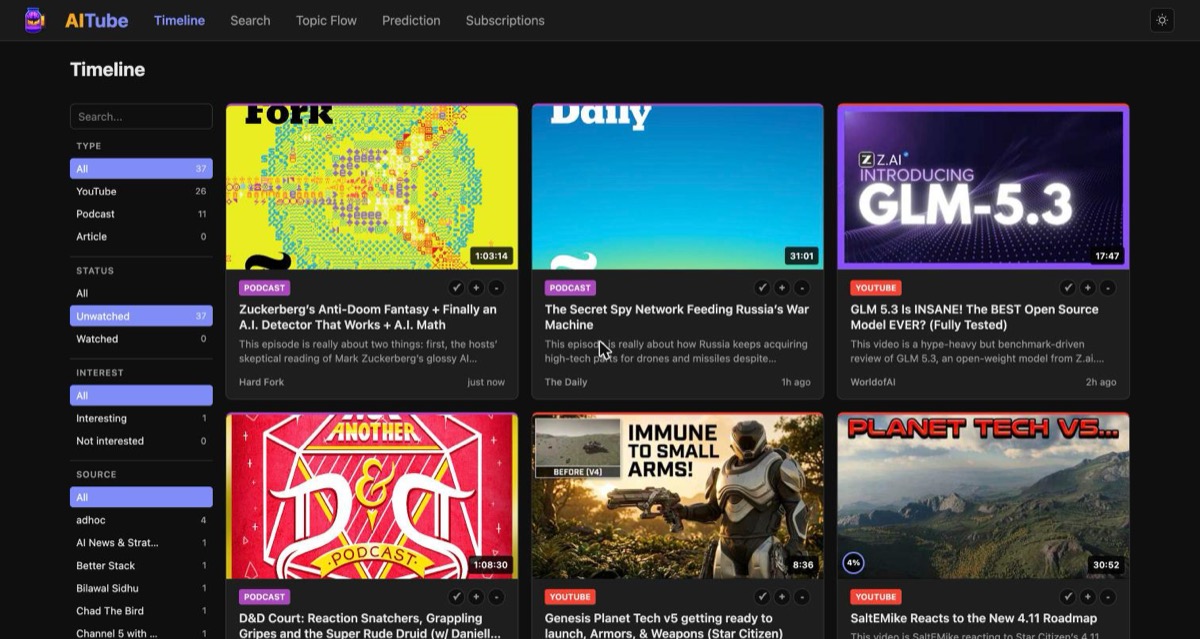
AITube: my YouTube, podcasts, and RSS in one timeline instead of three separate doomscroll feeds.
That last part matters most. Checking YouTube for what’s new is probably my biggest dopamine habit. Since I switched to AITube a couple of weeks ago, I mostly don’t go anymore. I go to my own thing, and my own thing doesn’t want anything from me.
The free-alternative firehose
One channel I follow inside AITube is Better Stack. They’re an observability company, so the audience is people who build software for a living, and lately a big share of what they publish is the free, open source alternative to some paid tool. Harper instead of Grammarly. A local dictation app instead of a paid subscription. PocketBase instead of Firebase. One is titled, with no irony I can detect, “Run Claude Code with Ollama for 99% Cheaper AI.” A lot of these look like open source clones: somebody pointed an AI agent at a popular tool and said make me a free version. That works now. I know because I’ve done it.
I run a home tabletop game, and I was paying monthly for Doodle to line up which weekend everyone could play. After enough of those videos, I realized I could just make it. Twenty or thirty minutes to clone the parts of Doodle I used. Now I host my own, behind OAuth so my friends log in from their phones without inventing another password. My Doodle fee is gone.
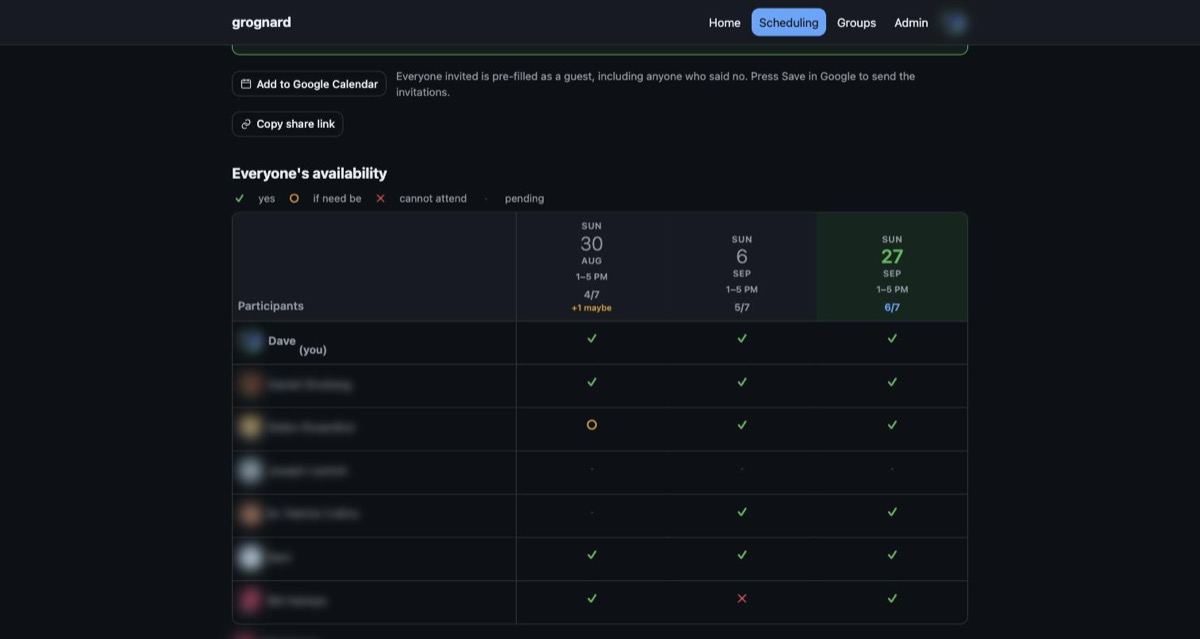
My twenty-minute Doodle. Friends' names and faces blurred, because they didn't sign up to be in a blog post.
So I forked it
The less voluntary version: when my company’s infosec team told everyone to stop using Granola, the meeting transcriber, I didn’t wait for an approved replacement. I forked muesli, an open source, local-first transcriber that does the Granola job entirely on my Mac, and bent it to fit. I added a microphone picker so it grabs the right input in a meeting, and switched off the local model’s “thinking” mode so summaries and transcript cleanup come back faster. Small changes, but they’re mine, and nothing goes to the cloud, which was the point. Do that a couple of times and you can’t unsee it. Half the small tools I pay for are a weekend and a clear spec away from being mine.
Building isn’t always the move, though. Last year, when I was actively running a public game group, I happily paid for Meetup. The value there wasn’t the scheduling, it was the audience, and no tool I write reproduces that discovery. When a subscription only gives me features I could build in an afternoon, I build. When it gives me a community, I pay.
Clean rooms and collateral damage
What makes this different from the old “go find an open source app” advice is how fast the clones appear, and there’s a legal trick under it. Copying what software does has always been fine, as long as you copy the idea and not the code. That’s the clean-room technique: one team studies the original and writes a spec, a separate team builds from the spec without ever seeing the code. It’s how Compaq and Phoenix legally recreated IBM’s PC BIOS in the 1980s and cracked the clone market wide open, and courts have treated that kind of reimplementation as function, not copyrightable expression.
Clean rooms used to be slow and expensive, so only companies bothered. Agents make them cheap. People now wire two models together, one to describe a tool and one to rebuild it from the description, so the builder never touches the original and produces a competing work instead of a derivative one. There’s a name and a product for it, “clean room as a service”, from a project called MALUS. Whether it survives a courtroom is untested. Simon Willison, watching a maintainer relicense a library this way, landed on “I have no idea how this one is going to play out.” Neither do I. But some of those free-alternative videos have exactly this smell.
This is catnip for the self-hosting crowd, and I feel the pull. What I keep snagging on is the collateral damage. If any decent tool can be cloned the week it gets popular, the small SaaS maker who spent two years on it never gets a business, and the open source project that inspired the clone gets imitators instead of contributors. Clean rooms take the idea and give nothing back upstream. The passionate little communities that make the good stuff in the first place are exactly what this hollows out, and I don’t know what replaces them.
Shadow CRM
The version that really drove it home happened at work. We run Salesforce. It’s enormous, and it takes months for my team to get a single feature added, so most of us stopped asking. Salesforce isn’t built for me. It’s built for the people who run Salesforce and the managers who want a clean view of the pipeline. As the person working a territory, I get a data-entry chore and a week-old snapshot of my own customers.
So I built my own CRM. At a software company. That has a whole team dedicated to supporting Salesforce. I don’t get API access, so every week I export what I’m allowed to into a spreadsheet and load it into a small local program on my laptop. Nothing leaves the machine. It’s a week old instead of live, but it’s mine, shaped like my actual job instead of someone else’s reporting needs.
There’s a name for this, shadow CRM: the tools people quietly build because the official ones don’t fit. Salespeople have hated CRM for years for exactly this reason. It feels like a tool for managers to watch them rather than something that helps them sell.
The snake eats its tail
Something about that Better Stack channel nags at me. It’s made for people who write software for a living, and the running message is stop paying for software. Follow that far enough and it turns on itself. I’m all for open source, but what this really does is boil every tool down to two ingredients, tokens and convenience, and the craft in the middle, the part I get paid for, quietly dissolves into a prompt.
The $4 Uber ride
The tokens are the other half of it. The reason I can build all this so casually is that they’re cheap in a way that probably isn’t real yet. I pay $100 a month to Anthropic and $20 to OpenAI, and work hands me $250 in Anthropic tokens at full price on top of that, which I burn through fast. I keep a little tracker of what it would all actually cost.
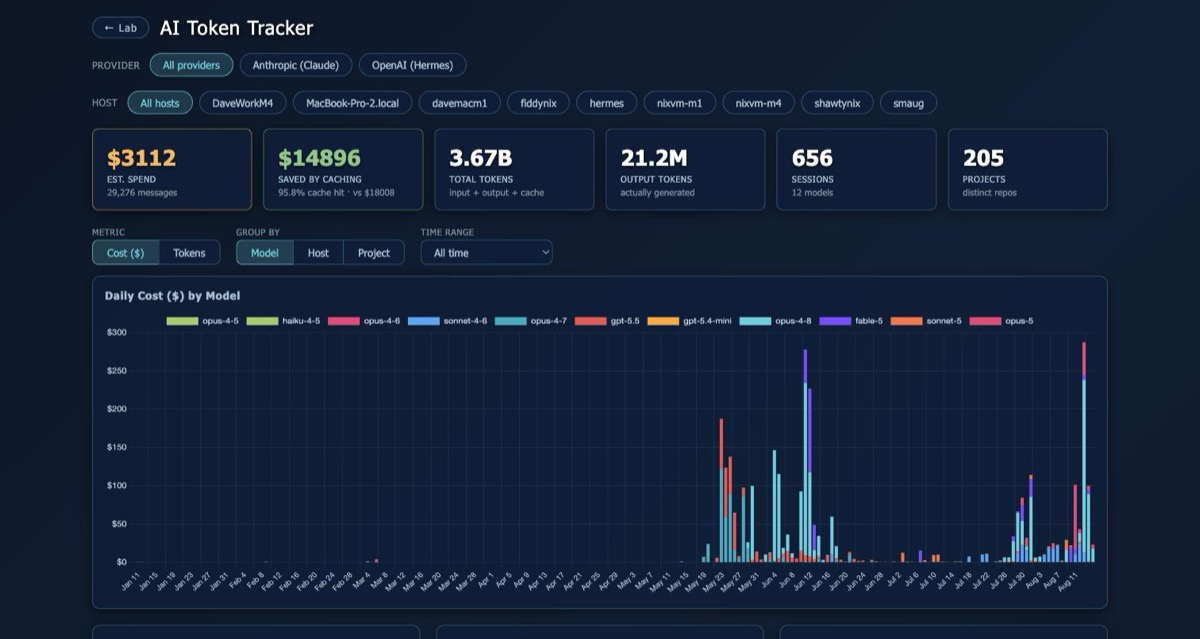
What my personal software habit would cost at sticker price, versus what I actually pay. The gap is the subsidy.
That $3,112 is the retail price of what I’ve run through these tools. I didn’t pay $3,112. A coworker once asked, “if you could go back to the days of $4 Uber rides, would you?” This is the $4 Uber ride. The AI companies are eating the difference to win the market, and the age of personal software is riding on that subsidy. When the price corrects, some of these little apps stop being free to maintain. I’m building anyway, because the tools I’m replacing weren’t going to take care of me either.
Where this leaves me
If the software I relied on had just kept being good, I’d still be a happy customer. Instead the good stuff gets acquired, abandoned, or turned against me, and the cost of building a replacement has fallen through the floor. So I build.
The spreadsheet people are still out there, and the low-code people, and now the agent people. I’m somewhere in the middle, making small apps that do one job and answer only to me. When I want one to do something new, I don’t file a feature request. I just ask Claude Code.