Off the Apple Watch, onto the Fitbit Air
I’m wearing a real watch again.
After years of an Apple Watch on my wrist, I switched to an analog wristwatch for style and a Fitbit Air on the opposite wrist for tracking. The Apple Watch was fine, but I spend most of my day already staring at a computer. The last thing I needed was a second screen, two inches from my eyes, buzzing every time someone @-mentioned me in Slack. I missed wearing an actual watch.
So now my dominant wrist is for telling time and looking like a person. The fitness tracking moved to the other wrist, to a thing I mostly forget I’m wearing.
I never went the Whoop route. The subscription model didn’t sit right with me, and I’m not an athlete. I don’t need recovery scores or strain coaching. I want step counts, sleep, and heart rate, and I want them to land somewhere I own.
The data actually comes out
I picked the Fitbit Air on purpose. Apple Health makes getting your own data back out genuinely hard, and the old Fitbits were a walled garden in their own right. The Fitbit Air syncs to Google Health, and the Google Health APIs give me real, structured access to the data without scraping or hacks.
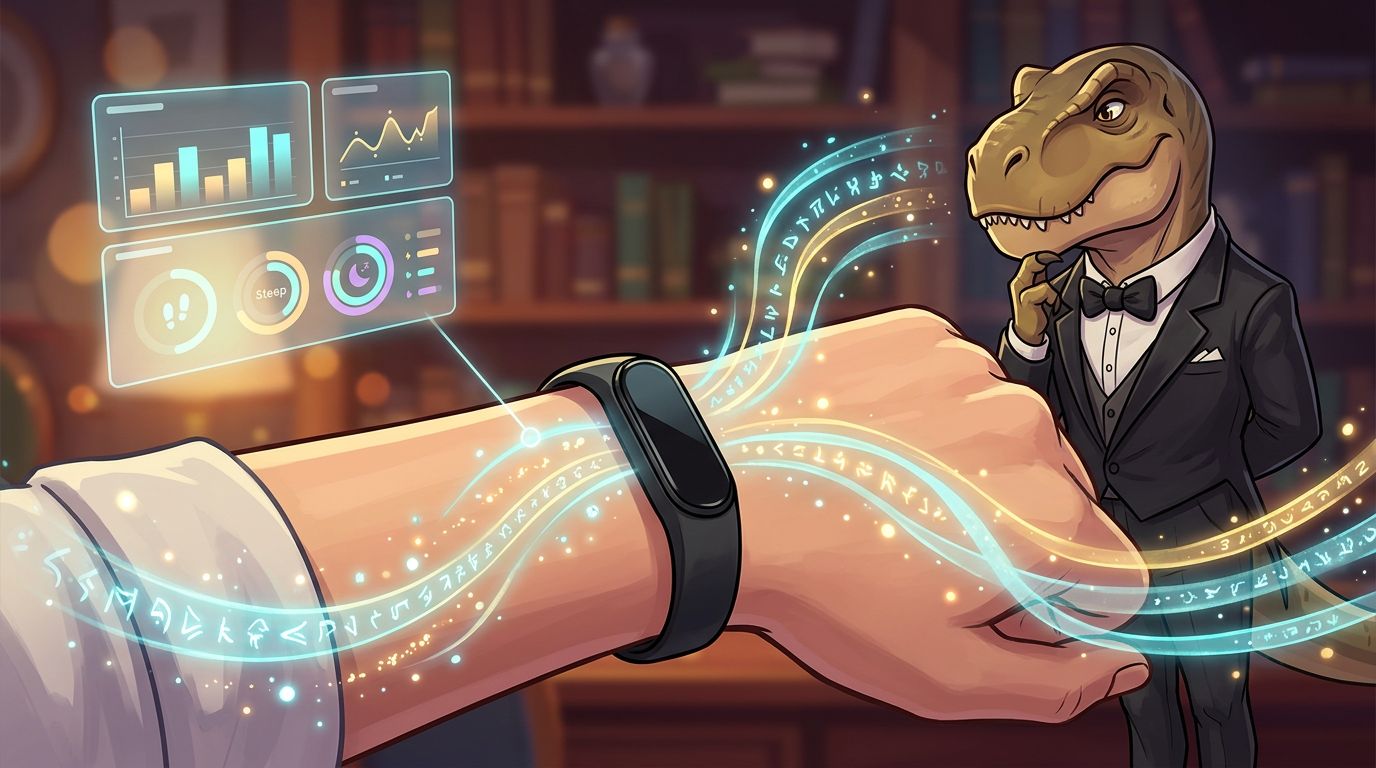
My home server polls the API every 15 minutes and writes the results into an Elasticsearch data stream. Steps, sleep stages, heart rate, workouts, all of it lands in one place. Rex can query it directly, and a static Kibana dashboard renders the same index. Same data, two consumers. The poller is on GitHub at derickson/fitbit-air-poll if anyone wants to lift it.
That sounds like work, and it would have been. With AI-assisted coding it was a weekend.
What I no longer do
The point of all this isn’t the pipeline. It’s what I stopped having to do.
- I don’t open the Fitbit app. I think I’ve opened it twice since setup, both times just to confirm something was syncing.
- I don’t start a workout. The tracker handles that on its own. If it gets one wrong, Rex can correct the record after the fact.
- I don’t hit a sync button. There isn’t one to hit. The pipeline runs whether I’m thinking about it or not.
- I don’t go hunting for my activity for the week. It’s already in the dashboard, and it’s already in Rex’s context when I ask about it.
I now have a single view of steps, sleep, and workouts without ever having to open my phone for any of it.
Tracking that is one less habit
I keep coming back to this idea: the best quantitative-self tracking is the tracking I don’t have to participate in. Every manual step is a habit I have to defend against my own laziness. Open the app. Log the workout. Sync the device. Each one is a tiny tax that eventually I stop paying, and the data goes patchy, and then the data is useless.
Fully automated tracking is the opposite. It gets more complete the longer I ignore it. Complete data is what lets me build the next layer and move to having an AI operating system for my personal data independent of subscription SaaS products.